Monthly Archives: November 2025

Mom

Mom became a mother over 70 years ago on this day. She was 22 years old, living more than 2000 miles from her family in Ohio. There was family support from Dad’s side. One of his aunts came to stay with them for a couple of weeks after I was born to help out. Yes, it’s my birthday! Mom gave me a birthday card yesterday and wrote ‘To my first-born son’ on it. It’s an appellation I carry with pride.

Mom had had some ideas of a career, but she quit college to marry my father and follow him wherever he went. I don’t think it was ever an issue that she might be the one to lead. It was the tenor of the times. The real women’s movement didn’t get rolling for another 15 years.

Mom’s leadership has been more subtle. She did her duty and took care of 6 children while my father went off to work every day. But when I look at my values and where they came from, I find that many things I do now align closely with what I now see is her approach to life. Not to minimize Dad. But I’ve done several appreciations of him in this blog (here, here, and here) and not one of Mom.

So, I want to appreciate Mom. She pays attention to her surroundings and takes action based on what she sees. She doesn’t wait for a crisis to develop, she heads it off. It’s a trait that I’ve noticed in myself that has stood me in particularly good stead in a professional environment and it came from her.

I don’t remember asking her, but I think it’s likely that she learned to sew as a young child. She was a child of the Depression. Her family wasn’t poor, but they weren’t rich by any stretch. I’m sure she wore lots of hand-me-downs from her older sister. She didn’t have her own bedroom until she was in high school.

As I was growing up, I took for granted that she made all kinds of things from cloth: dresses, shirts, aprons, napkins, blankets, you name it! It wasn’t high style, but it was functional. And I don’t believe any of us were embarrassed to wear the clothes she made. I remember going to the store and looking through Simplicity patterns with her. That was her wheelhouse.

I think it was some time in the ’70s that she got a high end sewing machine that could do lots of fancy stitches and the like. Before that, it was just her trusty SInger.

She hasn’t done much sewing in the last decade or so. Nevertheless, her sewing room is still fully outfitted and ready to go. I’m sure it gets used regularly, but only for small projects and repairs now. I sneaked in there yesterday and took this picture:
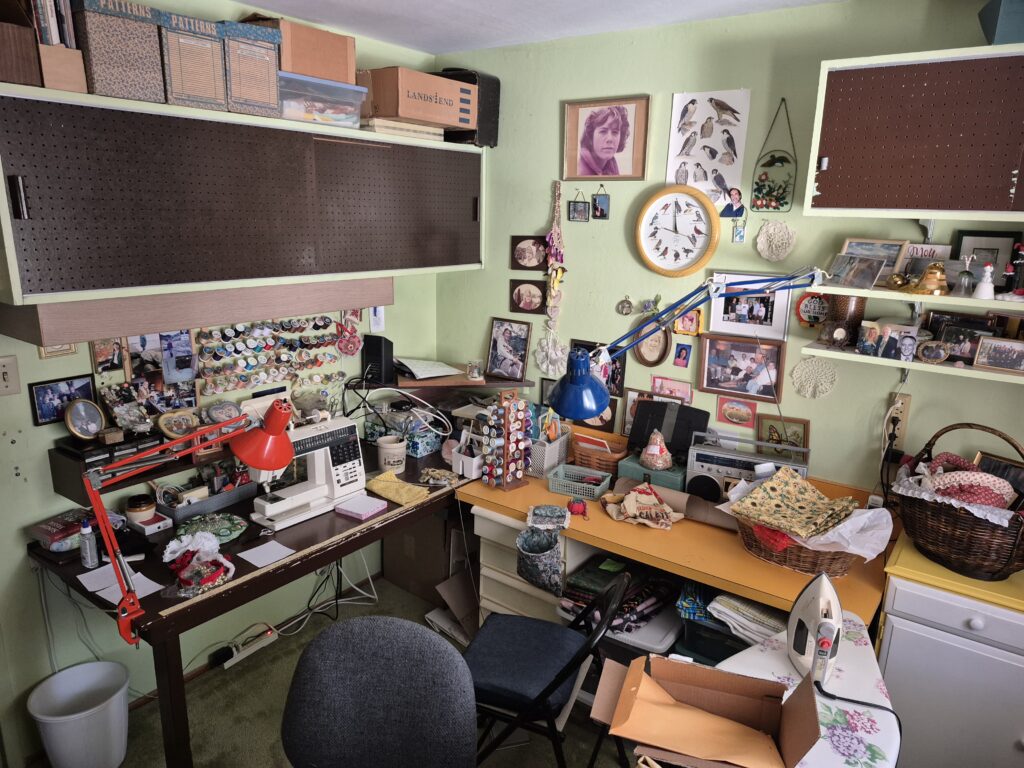
The wall storage, work surfaces and shelves were all built by Dad to her specifications.

When Sepi and I meet people and we talk about our families, we are always proud to talk about Mom. How  she’s in her 90s and in good health, and how independent she is. Come to think of it, we don’t say much about her sewing. Maybe it’s too subtle.

Thanks, Mom, for all the subtlety. You’ve been a quiet leader my whole life and I appreciate it!
Zach speaks

Apropos my recent post on ten years, I looked up a Zach journal entry today. It’s short. From 2014.

November 16, Weekly Reviewage

My long elusive week of kick-assery finally arrived, in the form of a 53.75 hour week, which is a full five hours longer than any I’ve recorded this fall. It as a pretty simple formula- getting shit done on a Saturday and doing enough on Mon-Wed to counter some lower totals on Thurs-Fri.
The major jump is in research, as I’ve really been going hard at this project with both a lot of time on the lit review and with interviews and transcribing and whatnot. One noticeable trend is the significantly lower amounts of time I’m spending on classes and schoolwork- that’s mainly me not spending as much time on stats. I don’t know if it’s because I’ve hit a wall with it or because there isn’t as much useful “work” to do on it but it’s a bit worrisome when considering what next semester will look like, when I assume I’ll have more real work, as well as more schoolwork. I guess the bright side is I have a better understanding of what I have to do for teaching, so that will (hopefully) be a bit less time consuming.

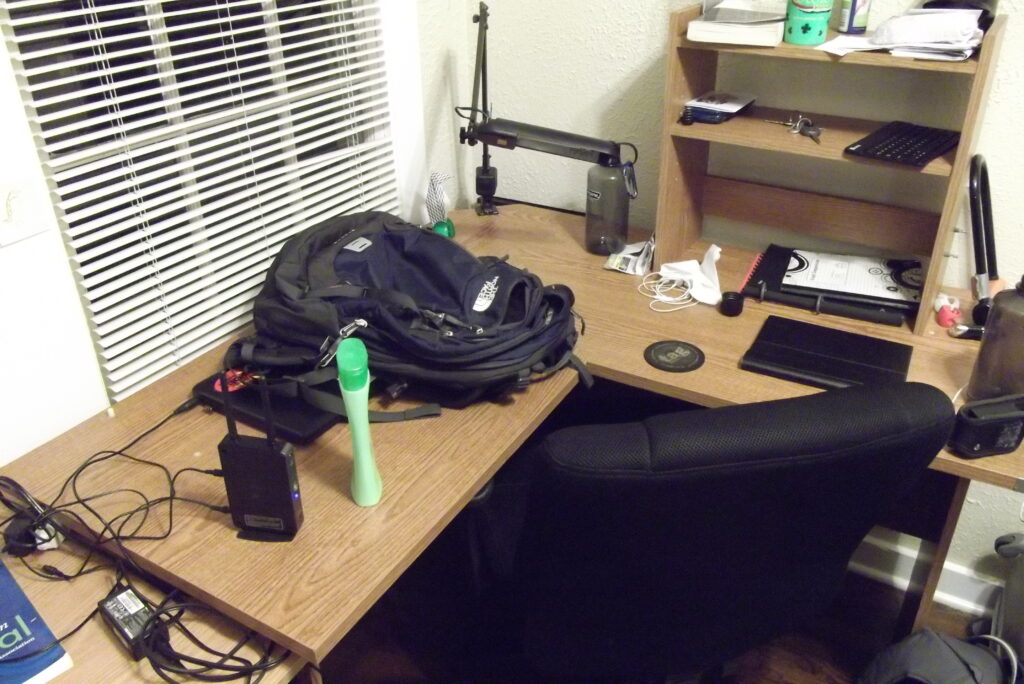
Apropos of nothing, here is a photo of Zach’s desk as I found it, a little more than 24 hours after his death.

Ten years

I marked ten years yesterday. No one said or otherwise communicated about it to me. It’s only my human obsession with round numbers, really. I don’t have anything profound to contribute. Just a sigh. By one measure it’s a long time. By others, not so much.

Zach’s presence has receded into the background. I still have my ‘Z’ in my medicine cabinet that I look at every day. I’m pretty sure the ‘Z’s that I put up around Davies Hall are still there. Most do not know what they are for, I’m sure. I went looking for some pictures of them. I remember taking them, but now I can’t find them. Grrr . . .

Thinking about ‘what would Zach do’ or wishing for his advice or perspective has pretty much stopped. We are all so different from ten years ago. Guessing what his life arc would have been is futile. Sad, of course, because of all the great potential that was there.

Not to say that I don’t think about it from time to time. I’ve been struggling to find ways to make this blog relevant and I think getting back to Zach might be a way forward. I haven’t looked at his journals for a long time.

In the words of Paul Simon, ‘Preserve your memories; they’re all that’s left you.’

Roger – Part II

*** you really should read part I first. This won’t make a lot of sense otherwise. ***

In the early days, we had a little difficulty understanding what each of our roles were. I finally had to tell him he was not allowed to operate any of the equipment. He was used to giving verbal explanations and I insisted that he write up his ‘designs’ before we worked on them. We had a big table that we used for a desk. It was kind of like a dorm room with a line down the middle sometimes! It felt a little silly sometimes when he sat at the same desk as me and typed out directions which he then handed to me. Believe me, though, it helped when a few hours later we had to set up on stage and he wasn’t always around. We had a document we could refer to. I think it helped to clarify his ideas, too.

Anyway, I think Roger saw the value in the process. It was a Union house after all! He realized pretty quickly that I knew what I was doing and he was able to concentrate not just on designing for shows, but improving the inventory and quality of the department. He interfaced with management (John Priest) and got a budget line which we talked over before he spent the money. I had the ability to write POs for supplies without having to ask him each time. I know I spent a lot of money at Zack Electronics which was just a couple of blocks away on Market Street.

We also worked closely with ProMedia, a sound company with offices in the China Basin building on Berry just off Third Street. Roger had been an early adopter in San Diego of the PA speakers manufactured by John Meyer’s new company, Meyer Sound. ProMedia became a dealer of Meyer sound speakers and did very well with them for many years. Meyer Sound is now recognized as an industry leader. ProMedia eventually merged with the Grateful Dead’s sound company Ultrasound. They are still big users of Meyer Sound equipment.

We got some very early Meyer speakers and we got Schoeps microphones which were very exotic at the time. Even today, they are not used much in live audio except by ProMedia. I think ProMedia has some of that original batch of Schoeps mics still in their stock.

In addition to improving the SFO Sound inventory, we got involved in improving the program and page system in the Opera House itself. It had been neglected for many years and was failing. When building management saw that we knew what we were doing, they allowed us to make changes in that system. Roger ran interference with, and secured funding from, the Chief Engineer and City management, at that time Beth Murray. We stayed on the Opera payroll to do all the work with John Priest’s acquiescence. The dressing rooms could hear the program and the Stage Manager’s calls too!

On the stage, we had a major challenge starting in 1983 with a new production of Richard Wagner’s Ring cycle. Roger had been in touch with director Jean Perre Ponelle and together they developed lots of ideas for this new production. Management supported us by giving us money for not only new speakers and microphones but also a new control booth.

By now, we had established that one of the stocks in trade for any Opera sound department was thunder. Roger contacted Randy Thom of Skywalker Sound (Apocalypse Now) and got copies of tapes of real thunder. Remember, nothing was digital then! All of our sound cues had to be prepared to run on reel to reel tape machines. Roger did all the prep work creating those cues.

In the Ring, Roger and Ponelle used our speakers and microphones to modify the sounds of some of the singers who sang from offstage. This was the type of thing that had been anathema to the previous General Director, Kurt Herbert Adler. Roger successfully managed the transition to a more modern outlook.

I don’t remember the exact year, but I believe it was 1983, that the Opera produced a concert in the SF Civic Auditorium featuring the Opera Orchestra and Luciano Pavarotti. Roger handled all the details of the sound system and micing techniques resulting in a very successful presentation in a large hall. Pavarotti and his manager were very impressed – as was Opera management – and soon Pavarotti, with Roger handling the sound systems, were presenting concerts in very large arenas around the world. For the most part, I was not involved in those.

My memories of the second half of the decade are not as strong. The 1985 complete Ring cycle was the high point. We had a stable crew and facility. Sound requirements for a particular opera would arise and, if Roger was unavailable as he more and more was, we were importuned to come up with a ‘design’. Roger had established the criteria and we followed them.

I left the Opera in 1990 to move to Grass Valley. Roger hung on for a while but he was eventually deemed unnecessary by Opera management. I was busy with my young family and the need to make a living so we lost touch with each other.

*** Eventually, I hope to add a Part III, which would be some detailed comments about some of the significant shows Roger and I did in the 1980s. ***

Roger – Part I

Roger Gans died a couple of months ago. I heard about it from Gus, who had seen it on Facebook. Roger’s daughter Caitlyn had shared the news.

I have to go back a ways to set the scene for my meeting with Roger. I had been working as a stage technician at Flint Center on the DeAnza campus until June 1978 when I was laid off following the passage of Proposition 13. At that time, there was a casino building boom in Reno. A lot of my theatre friends had gotten jobs at the big ‘Hello Hollywood’ show at the MGM Grand there so I went up and applied for a job.

I didn’t get hired at the MGM but I got in at the Sahara Reno. The Del Webb Corporation was building a new hotel and casino in downtown Reno. There was a showroom, but also a smaller room and a convention space with some meeting rooms. Of course there were slots and tables for gamblers.

All of this needed sound systems and that was what I wanted to do. Mostly at the Sahara I was tending to broken microphones in the pits.

Anyway, the whole thing was over extended and not really ready for the business they thought they were going to have. I got laid off again in September. This was after moving lock stock and barrel to Reno.

Word on the street was that the Stagehands’  Local 16 in San Francisco needed sound people so I went down there and got work immediately. Not sound work, but work. Perrie Dodson was in the Union office and I had worked with Perrie when he had been bringing the Symphony down to Flint in previous years.

I took whatever they had for me – mostly carpenter jobs: midnight turnaround crew at the Opera House, SF Civic Light Opera shows at the Orpheum – but kept telling Perrie and Eddie that I was a sound man and wanted to work sound.

In December 1979, the Golden Gate Theatre was reopened as a Broadway road house (Chorus Line, in its first national tour! I worked the load in.) Jim Wright had been doing the sound for the SF Opera but he moved to the Golden Gate. I now knew there was an opening.

In March, the Opera went to the Palace of Fine Arts for their Spring Opera season. I got the call, but Tim Morgan, from the SFO electric crew, had been designated as the sound man. This was consistent with the way the Local 16 had staffed sound positions for many years. Tim was a neighbor of Eddie Powell in Tiburon. I was still a carpenter.

Tim was (and is) a great guy, but he knew nothing about sound. Roger Gans was already the sound designer for the Opera and got quite frustrated when Tim couldn’t put together what Roger wanted.

After Spring Opera ended, Roger made a fuss to John Priest, the Opera’s Technical Director. John went to Eddie and asked him to send him someone better. Enter me!

In July, Eddie sent me over to the Opera House to replace Jim Wright as the sound man. What he didn’t tell me was that Jim Wright had been a part time sound person, also filling roles in the electric department. I just dove into the sound world, ignoring the electrics. George Pantages, the head Electrician, let me go on and eventually replaced me on his crew. (I was technically under George at that time.) Jim had finagled a storage location in an unused room in the basement so I spent a lot of time down there organizing it.

One day, this guy shows up at this room and introduces himself to me. It’s Roger. I had actually met Roger before but I did not know him at all. He was associated with Dan Dugan but had also worked with Dick Garretson and the Beach Blanket Babylon people. Dick used to come down to Flint for the Nutcrackers we did at that time.

Those were the days when smoking was permitted inside buildings and Roger smoked a certain kind of cigarette called Sherman’s. They were pretty vile. Roger always went out in the hallway to smoke which I appreciated. Not much by today’s standards but nice for the time.

We were about the same age. I think Roger was a little older.

We both were passionate about sound, especially theatre sound. Roger worked for the Old Globe Theatre Company in San Diego. He had worked closely with composer Conrad Susa on many productions of Shakespeare there over the previous few years.

He had gotten in at the Opera a couple of years before and had chafed at the difficulty getting his designs executed with antiquated equipment and under qualified sound men.

*** To be Continued in Part II ***