Tag Archives: Dad

Mom

Mom became a mother over 70 years ago on this day. She was 22 years old, living more than 2000 miles from her family in Ohio. There was family support from Dad’s side. One of his aunts came to stay with them for a couple of weeks after I was born to help out. Yes, it’s my birthday! Mom gave me a birthday card yesterday and wrote ‘To my first-born son’ on it. It’s an appellation I carry with pride.

Mom had had some ideas of a career, but she quit college to marry my father and follow him wherever he went. I don’t think it was ever an issue that she might be the one to lead. It was the tenor of the times. The real women’s movement didn’t get rolling for another 15 years.

Mom’s leadership has been more subtle. She did her duty and took care of 6 children while my father went off to work every day. But when I look at my values and where they came from, I find that many things I do now align closely with what I now see is her approach to life. Not to minimize Dad. But I’ve done several appreciations of him in this blog (here, here, and here) and not one of Mom.

So, I want to appreciate Mom. She pays attention to her surroundings and takes action based on what she sees. She doesn’t wait for a crisis to develop, she heads it off. It’s a trait that I’ve noticed in myself that has stood me in particularly good stead in a professional environment and it came from her.

I don’t remember asking her, but I think it’s likely that she learned to sew as a young child. She was a child of the Depression. Her family wasn’t poor, but they weren’t rich by any stretch. I’m sure she wore lots of hand-me-downs from her older sister. She didn’t have her own bedroom until she was in high school.

As I was growing up, I took for granted that she made all kinds of things from cloth: dresses, shirts, aprons, napkins, blankets, you name it! It wasn’t high style, but it was functional. And I don’t believe any of us were embarrassed to wear the clothes she made. I remember going to the store and looking through Simplicity patterns with her. That was her wheelhouse.

I think it was some time in the ’70s that she got a high end sewing machine that could do lots of fancy stitches and the like. Before that, it was just her trusty SInger.

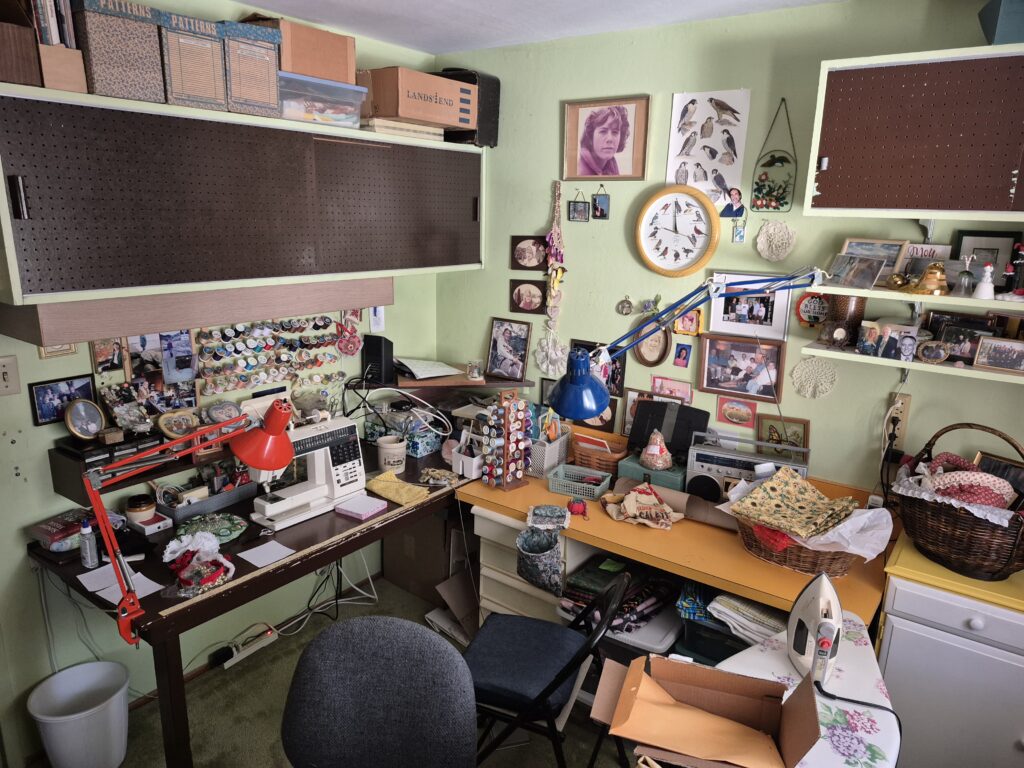
She hasn’t done much sewing in the last decade or so. Nevertheless, her sewing room is still fully outfitted and ready to go. I’m sure it gets used regularly, but only for small projects and repairs now. I sneaked in there yesterday and took this picture:

The wall storage, work surfaces and shelves were all built by Dad to her specifications.

When Sepi and I meet people and we talk about our families, we are always proud to talk about Mom. How  she’s in her 90s and in good health, and how independent she is. Come to think of it, we don’t say much about her sewing. Maybe it’s too subtle.

Thanks, Mom, for all the subtlety. You’ve been a quiet leader my whole life and I appreciate it!

Dad the list maker

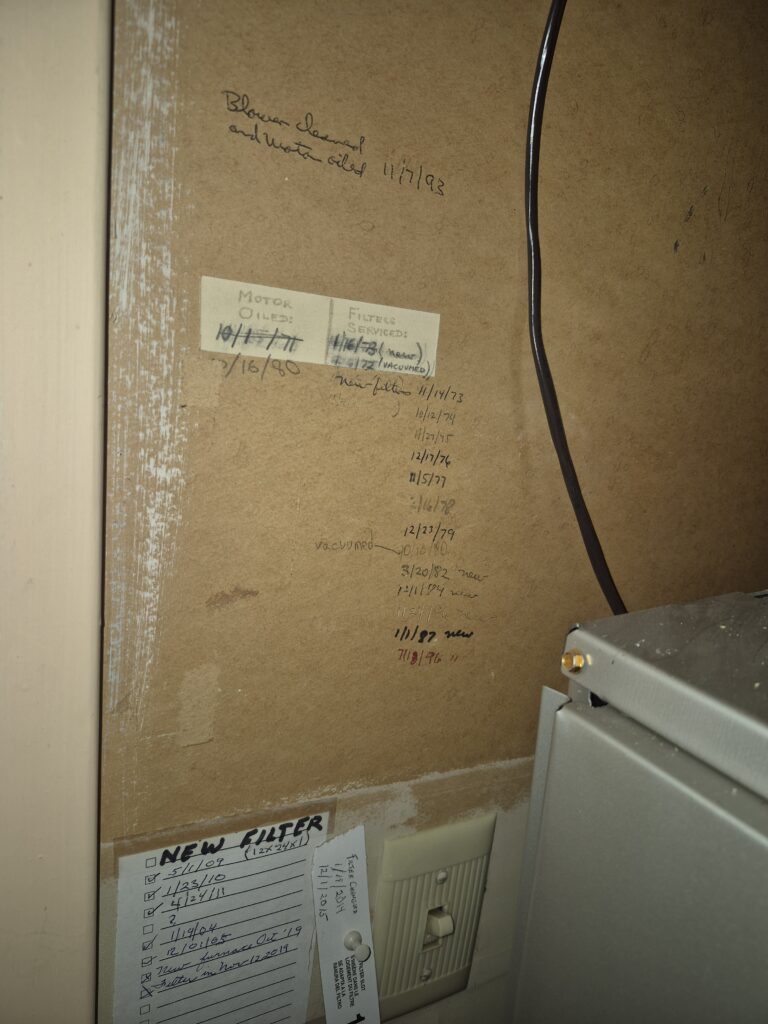
I only have one photo to support my thesis, but I’m going ahead anyway. Here’s the photo:

This is a view of the interior of the furnace closet. All the notations are in Dad’s writing documenting the dates on which he had changed the furnace filter.

He had installed a water softener not long after we moved to the Santa Clara house. The water softener uses salt pellets which periodically have to be added to a barrel in the garage. That system has been replaced at least once in the 60+ years and the one now in use is 15 or 20 years old. The lid of the salt barrel is filled with similar notations of when he had added salt pellets. It’s even more dramatic looking than the furnace closet.

In Mom’s car at this very moment, I am sure – without looking, I’m at home as I write this – there is a little book with notations showing every gasoline purchase since the car was new. She has faithfully carried on this tradition of Dad’s for years now. I’m not as sure that she is keeping the service records there as Dad did.

For many years, I carried on this tradition in my own vehicles as well. I finally realized that there was no benefit to me so I stopped. I can look at credit card records if I have to although I can’t use them to calculate mileage, as he did. I am guilty of occasionally putting dates on things that I use: ibuprofen, laundry detergent, potato chips, toothpaste, for example, so that I can gauge how long they actually last. Perhaps that was Dad’s motivation. I prefer to think that he was a scientist to the bone and always wanted to work from a position of factual knowledge.

To be fair, I never saw dates written on any perishables at our house growing up. Perhaps, with 6 kids, things got used up so fast it didn’t matter.

1975

50 years ago . . . January 1975. I had just turned 21 the previous November.

I was living in the house on Bollinger with Tom, Bill and Nick. We had band gear set up in what would normally have been the dining room. None of us (evidently) knew anything about cleaning house so the place was filthy. Dirty dishes would stack up in the kitchen until someone – usually Nick – would crack and clean them up. Did we have a vacuum cleaner? Don’t remember.

Tom had brought his two cats over from his apartment in Sunnyvale but was concerned that they would run away so he kept them locked in the garage where they slowly went crazy. I only went out there a couple of times, but I remember seeing the exposed studs of the garage walls badly scratched all around up to a height of about 4 feet. I don’t know why we didn’t even let them in the house. Maybe we weren’t supposed to have pets.

I was in my third year at DeAnza. I had finished the requirements for a Music degree except for the Gen Ed stuff but stayed on the extra year so I could play bass in the #1 band. No question, that was a great experience. I had exited my old band, April, with Tom and Nick, in order to concentrate on jazz. They had reincarnated it with some new players and called it Dry Creek.

I don’t remember if Tim I and me had started Higher Ground yet. I was doing student setup work at Flint Center for a pittance. I had pretty much tapped out the classes available in the Theatre department so my only contact with them was when they came into Flint.

The four of us had moved into the Bollinger house a year earlier on a 14 month lease. The owner didn’t want to have to deal with finding tenants during the holidays again so he added two months to the standard 12. I wasn’t making enough money to continue and I’m pretty sure the owner wanted us out of there. (I’ve driven by that house recently and it looks just the same only rattier. I don’t think it has even been painted in all that time.)

There was drug use there. Mostly weed, but I remember seeing cocaine at least once. I never got into that and I was moving away from smoking already. Drinking. It was while I was living at that house that Tom’s mother got remarried and I got completely wasted on cheap champagne. I can still remember the spectacular hangover the next day.

It was probably around this time that I went to Dad and asked him if I could move back home. He said that was fine. It was a big deal for me because I was determined to be independent even though I really wasn’t. In hindsight, it is interesting that I went to Dad only. I think I even drove up to Menlo Park to talk to him at his office just so it would be him only. Maybe I was embarrassed to show up at his house and have to ask in front of everybody. I’m pretty sure I had stayed away as much as possible during the 1974 year. Mr Independent!

For income, besides working at Flint, I was playing music gigs on bass. I was in a quartet with some people (Susie, Greg and Tony) from the DeAnza band, We mostly did standards from fake books although I remember Susie wanting to branch out to more pop stuff. We didn’t really have a singer so that didn’t go very far. I was raw and learning fast but the others were good jazz players. I’m pretty sure I was the oldest. I also played in a big band run by a guy named Joe Doll. We did swing tunes from the 40s and some newer pop things (‘Tie a Yellow Ribbon’) for older audiences. I may or may not have date books from those years . . . (not looking now).

. . .

OK, I did some research. I did have Higher Ground so there was a little income from that as well. I think it wasn’t until later in the year that I started playing in the evening jazz band at DeAnza (technically it was a Music Department class). There was no money in that but another great experience. They called it the Daddy-o’s because most of the members were older and very experienced. Bass players were in short supply in those days! The Daddy-o’s were led by a pianist named Bob Russell.

With the death of Jimmy Carter recently, Sepi and I have talked a lot about the politics of those years. I’m sure I was aware of those things but it wasn’t important to me. Tom and I, in particular, were big Giants fans and we went to some games. How clueless we were going to a game in Candlestick at night in clothes we had worn that day in the South Bay! For those who don’t know, Candlestick was famously cold at night. Shorts and a light jacket didn’t cut it but we just didn’t think about it. We were in our little cocoon.

Later in the year I got a job at a department store called Mervyn’s working the stock room. I was able to move out again, this time to a room in a small house with Peter I in Mountain View. That’s a story for another day.

Cognitive test

I don’t remember where I heard the story. I think it was about the time that I had to witness Dad go through a cognitive test. I think it was about two years before he died. Mom had been saying for a while that he was ‘losing it.’ and all of us kids didn’t believe it.

Watching the test made me a believer but it was heartbreaking. In hindsight, that could be considered his day of death for me. He was clearly no longer the man he was.

Anyway, I think the story is kind of funny. It couldn’t have been Dad, though. It’s not his style. He took the test seriously and tried his hardest to answer the questions correctly. Interestingly from this remove, I don’t remember any discussions with him about his condition. Of course there was nothing to be done but work around it.

So, the story goes that a man was being given a cognitive test. The tester asked questions like how how much time is there between 1:45 and 3:30 and the responder was clearly having trouble. Then the tester asked, ‘Who is the President?’ and the man responded quickly:

‘That asshole!’

Dad’s house

When I was a teenager, I was highly annoyed (to say the least) at the arc of my father’s life. He went to college, found a girl, graduated, got a job, got married, had kids, bought a house and . . . lived happily ever after. He was completely devoted to my Mom. Any arguments they may have had were hidden from us kids. He retired from a job he held for over 40 years. Finally, he died in the same house he had bought over 60 years earlier.

Perhaps I’ll address those feelings here someday. Today I want to talk about his house that he bought in 1958, that he raised 6 kids in and that my mother still lives in.

Because she still lives there, I have the privilege of going back to this house of my early years and viewing it with a different perspective. It’s different in many ways. There was the major addition in 1965, which I lived through. There was the reconfiguration of what was originally a ‘den’ and later my bedroom into a ‘sun room’ that is now the location for all large family dinners. Outside, it’s even more different. I think there is one tree left that was extant when I was a youngster.

So, what am I getting at? I was out in the back yard yesterday and went into the little shed on the back corner of the house. Dad built that shed. We were looking at the dripper system that is all over the back. Dad laid that out and it is still functioning reasonably well. On the edge of the deck opposite where most of the plants are is a hose bib. Dad plumbed it in copper pipe. The concrete walk on the side of the house was poured by Dad. I remember him reading about how to do exposed aggregate and trying it on that walk. It didn’t work out so well but the walk is still there and hasn’t fallen apart.

In the garage, there are screws, nails, hooks, shelf brackets, and other useful hardware, all sorted into boxes and neatly labeled. His toolbox is filled with inexpensive tools that were good enough for him. I made a living using tools, so I look at these sometimes and sigh if I have to use one. I can get the job done with them, though.

The cabinets and shelves in the garage were all built by him, as were many of the cabinets and shelves in the bedrooms and ‘family room’ (now known as the office). The construction isn’t fancy, but it has held up. We got a contractor for the major addition I referred to, but Dad drew up the architectural drawings.

Those who are gone live on in our memories. My memories of Dad are many, but being at his house and seeing his work is a different kind of memory. If I wanted to, I could show any of those things to another person and say, ‘My Dad did that!’ and it would tell them the kind of person Dad was, even if they had never met him.

That’s pretty cool!

Birthdays of dead people

Dad would have been 92 yesterday. I marked the day but didn’t think of making a post about it until too late in the day. His loss has receded into the general noise of the past.

I suppose it happens to everyone. It happened with Zach, too. The date of Zach’s death passed me by completely this year. I literally didn’t think about it at all until a day or two later. That’s a first. I did have an idea for a post on Zach’s birthday but the day slipped away from me. He would’ve been 33.

With Dad, I’ve been better able to recall the earlier times when he was his real, dynamic self. The last two years of his decline are what we have (mostly) forgotten.

The other day, Mom had me get out a walker that had been purchased for him. She wants to have it nearby for herself now. It led to some talk about Dad’s last days but in a fairly dispassionate tone. Maybe elegiac or wistful might describe it better. We talked about her and Mary getting him to Christmas Mass in the rain. It turned out to be his last time out.

Mom had told me she got emotional on Zach’s death date this year but the thought of Dad’s passing doesn’t have the raw emotion attached to it. His death date is coming up in about three weeks, tho’ . . .

I’m glad I’ve been able to change my focus to birthdays rather than death days. It’s part of looking forward, I believe.

So, Happy Birthday Dad and Zach! I miss you but I am working on bringing my memories of you to bear in a positive way.

styptic pencil

Mom had given me Dad’s overnight kit several months ago. At the time, I was getting ready for my Europe trip and thought I might use it instead of the one I had already. It languished in a corner until the other day, when I finally took it out and looked through it.

Pretty much everything in there was unusable but it did give me a glimpse into Dad’s way of thinking. There were 35 mm film canisters with various pills (all OTC, cough drops and pain relievers, no prescriptions). A couple of razors, one electric shaver and one safety blade type. No shaving cream and no Old Spice. Band Aids. A little sewing kit. A shoehorn. And a styptic pencil.

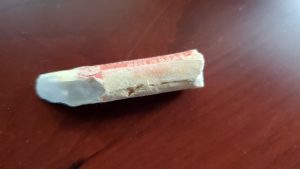
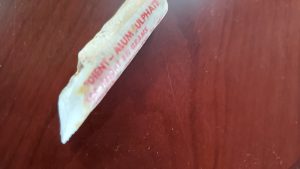
I knew  what it was as soon as I saw it but I couldn’t believe that he still had one. More amazingly, I think it was the same one that he used with me when I was learning to shave! There were a lot of cuts in those early days.

Alum Sulphate, it says. Since, after 50 years, I thought I might have mis-remembered it, I did an Internet search and found that not only did I remember it right, they are still available! Wow! I don’t know if I’ll have the courage to actually use it, but I’ll keep it around for a while and see.

Dear old Dad!

community

I don’t have a plan today. I have time to write. Lots of it, although I did say I wanted to get out and take a walk before the rain starts. It’s cloudy and blustery right now, but patches of blue are still showing through.

Teresa’s birthday is tomorrow. Jane has set up a Zoom meeting for all of us to join virtually to celebrate. I gather Zoom is an app like Skype but oriented more around groups.

So I am thinking about community. Sepi and I are spending a lot of time on FaceBook. Why? Because we crave community. I believe it is hard wired into the human animal. That is why slowing the spread of this disease is so difficult.

In my case, my course of action was pretty straightforward. First it was no groups of 1000, then 500, then 100, then 10. Now in Germany, no groups of more than 2 – 2 people! – are allowed to gather in public. The Symphony at one point was going to do a radio broadcast of a concert with no audience but then the number was changed down to 100. It takes 10 or 15 people to put the orchestra on stage and the band is about 100 so . . . no radio broadcast. In fact, no nothing. We’ve all been sent home.

My craft, my industry is dead in the water because the whole thing is predicated on people gathering. It seemed to simple and foolproof only a few weeks ago.

Maybe at some point, concerts will be redefined as essential services and allowed to go on. Although as my friend Kim said in another context a couple of years ago, ‘Without your health, you have nothing. Nothing!’ We were talking about someone who was wealthy but got sick and died. Now there is a politician in Texas suggesting that old people should allow themselves to die so the economy can do better. As someone commented on FB, how is it that so many psychopaths have gotten themselves in positions of power?

When I put in the tag for community, I thought surely I had used it before. It’s a word that Dad used a lot and I thought I had written about it. He consistently referred to the Sunday Church service that he and Mom went to as the ’10 am community’.

I remember years ago when we used to have Mass in odd places like the lawn at Maryknoll, Dad would bring up Jesus’ comment that ‘whenever two or more are gathered in my name, there I am.’ His point was that it didn’t have to be a dedicated structure to find the presence of God.

But it does have to be a human gathering, and that is in short supply right now.

In the US Congress, there are rules in place requiring physical presence in the chamber for voting. There is talk now about relaxing those rules. However that plays out, despite Zoom and Skype and Teams whatever other software is out there for getting people together, humans will always need to gather. Community is too important to leave to the machines.

Dad’s hangers

I guess it was about a month ago that Mom invited me back to her and Dad’s bedroom to pick out what shirts I wanted from his closet. We wore the same size.

They’ve been coming up in the rotation for the last week or so and I noticed that the hangers they were on were built like tanks. Nowadays if you take your clothes to the cleaners, they come back on wire hangers inside their plastic bags. It wasn’t until I felt Dad’s hangers that I realized how much these simple little things have changed.

No picture, because they look exactly the same. Well, not exactly, because Dad’s old hangers have some kind of black coating on them. The newer ones are a brass metal color and can be bent rather easily. Dad’s black ones weigh about 50% more and are much tougher.

Someone probably did a study and found that clothes hangers didn’t need to be so strong. Kind of like modern cars compared to cars from the ’50s and ’60s. My Corolla has dents that my old 1964 Valiant would laugh at.

At our house we are using mostly the new plastic hangers. I like how they give the shirts a little more area to sit on. I’m going to keep Dad’s real steel hangers, though. Like the shirts themselves, they are a reminder of him.

Dad’s story

I don’t remember exactly how this came up. It was probably related to all the contact with relations that Sepi had on Nowrooz.

She was aware of my cousins in Germany. I had told her of my trip there in 2017 and I had said that any trip we would take to Europe would have to include a visit with them.

Just the other day, she was asking what was the exact relationship that I had with these people so I told her about how Zacharias Hangauer had left Germany and came to America in 1869, married and had a family that included my grandmother. This led naturally to questions about how I knew of the German relatives.

I was astounded that I hadn’t told her the story before. It is one of my all-time favorites.

I present it here in full.

My Search For Unknown Kin
by Bernard J. Wood

How it Came About

In September 1975, I had the opportunity to attend a conference on surface science held at the University in Namur, Belgium. Nancy and I had often talked about visiting Europe, and this seemed to be the time to make our oft-discussed visit a reality. A three-week visit was reasonable, within the constraints of our family responsibilities and our financial resource. The conference in Namur occupied two weeks, so we had one full week to do sightseeing on our own in Western Europe.

When we looked at the travel guides and maps we realized that 52 weeks would hardly be enough to visit every place we wanted to see! We had to make the hard decision to limit our excursion to a few places. The principal limitation became geography; we didn’t want to spend all of our time traveling, so we chose three places that were reasonably close together, yet had some special meaning for us.

We selected Amsterdam, because two friends live there; one is a young woman, Johanna (Honny) M., who was an exchange student in our community a number of years ago; the second is Rutger van S. (and his family) who spent a year at SRI as a visiting scientist.

We chose Paris for the same reason: George A. is an old friend from SRI, and Mike and Trish C. and their family moved away from our parish in the middle ‘60’s. And besides, everyone wants to see Paris!

Our third choise was somewhat off-beat and very personal. The twin towns of Berkastel-Kues, located on the Mosel River in Germany, were the home of my ancestors in my mother’s family. I knew from conversations with my late Aunt Elizabeth that my grandfather Hangauer had emigrated from Bernkastel-Kues sometime around the middle of the 19th century. Indeed, Elizaceth had given me and old souvenir book of the Mosel Valley which showed photographs of Bernkastel-Kues. We had no inkling that any living kin resided in this region at the present time, for noe of my aunts in the American Hangauer line, whom I had know, had ever mentioned the existence of living relatives in Germany. Nevertheless, the reasonably convenient location of Bernkastel-Kues and its connection with my ancestors compelled us to include it in our itinerary.

The Journey to Bernkastel-Kues

On Tuesday morning, September 16, we boarded the Lorelei Express in Amsterdam and commenced a four-hour rail journey into Germany to Koblenz, where the Mosel flows into the Rhine. There we transferred to a Paris-bound train that took us west to the town of Wengerohr, where we again changed trains, this time to an inter-urban type of local that terminated its run in Bernkastel-Kues.

Bernkastel-Kues are twin towns situated on opposite banks of the Mosel, and connected by a bridge. Both are nestled into the hillsides that rise rather steeply from the river’s edge. The vineyards that cover the hills reveal the principal industry of these towns; winemaking. The second industry is tourism. Bernkastel-Kues is a resort area where people come to hike, breathe the fresh air and relax in the sun. the towns have the appearance of classic Alsatian villages, with narrow, winding, cobblestone streets lined with gabled houses constructed of wood and masonry. The village square in Bernkastel looks as if it might have been designed and built by Walt Disney; a perfect stereotype and perfectly charming!

We stayed in a hotel in Bernkastel called Doktor-Weinstuben. The name had nothing to do with the medial arts; it referred to a tavern wherein the famous Bernkasteler-Doktor wine was kept and served!

The Search

We spent the evening exploring the town and the shops. Next morning we inquired of the hotel clerk about the name Hangauer. He indicated there were people with that name in town, but he didn’t know whether they had been around very long, or if they had any connection with Hangauers in America. He suggested we visit a famous historical library in Kues, called the Cusanus Stift, where we might obtain some genealogical information. Unfortunately, the Cusanus Stift was not open until 3:00 p.p., so we had to pursue our inquiry through another channel.

Examination of the street map of the town revealed a number of churches with adjacent graveyards. We walked to the nearest one and looked for the name Hangauer on the grave markers. But we drew a blank. So we walked a few blocks to the next churchyard, St. Briktius, and repeated our scan. Here we found a simple wooden cross with the inscription “Hans Jos. Hangauer”.

The pastor’s house was the next logical place to visit, but the location wasn’t obvious. There was no indication of the priest’s residence in the vestibule of the church. We stepped out onto the street and looked about. Houses and small stores, but no sign or symbol that would identify a parsonage was in view. A woman, however, was leaning out a first stroey window of a nearby house. I approached her. “Guten morgan, meine Frau. Bitte, wo ist das Hause auf der Pastor?”, I said in my rudimentary German. The woman understood me, however, and spewed-out directions in a cascade of words, only a few of which I understood. “Langsam, langsam”, I pleaded, and she repeated her directions more slowly, pausing at strategic points to make sure I understood. “ Auf den Strasse, lenks . . . , richt, . . . ober den Eisenbahn . . .”

It was several blocks distant, and after we had come to the vicinity of the house, we were still unable to identify it. A young mother with two children in tow, approached us on the street. I repeated my inquiry to her. She nodded, then directed her smaller child to take us to the pastor’s house, which turned out to be just a half-block away. We rewarded the young guide with a coin, then rang the bell. The priest came to the door. “Sprechen Sie Anglais?” “Nicht.”

Ach! So I launched into my inquiry with what surely was quite vulgar German: “Meine Name ist Bernard Wood. Ich auf Amerika gekommt. Die Name auf meine Mutter ‘Hangauer’ war, und ihr Vater auf Bernkastel-Kues in achtzehn-hundert-sechzig or siebenzig getreben . . .” The pastor listened patiently, then invited us in. He went to a file and removed a few cards. Then he explained that although he had several Hangauers in his parish, he had no idea whether they were related to a person who emigrated to America in the mid-nineteenth century. However, there were tow sisters, unmarried, who were born around the turn of the century and would surely be able to remember if an uncle had emigrated to the USA. He gave us their names, Anna and Cilli Hangauer, and directed us to their home, just a few blocks away. We thanked him and proceeded directly to Goethestrasse 24.

The Discovery

The bell brought a white-haired woman to the door. I began again my spiel, prefacing my inquiry with Pastor Störmer’s name to lend some kind of respectability to my presence at her door. The woman was not impressed, and with a puzzled look protested that she knew of no relatives living in America. I had decided that my inquiry was futile, that there was no connection between these Hangauers and my grandfather. But before leaving I made a final effort to clarify when and where my grandfather emigrated to the USA. “Aber, meine Grossvater nach Amerika in achtzehn hunderd-siebenzig, in dem Stadt Buffalo in New York getreben!” Just as I was speaking this sentence, the other sister appeared in the front hall. At the word “Buffalo” her face lit up and she rushed to the door. “Buffalo, New York. Ja, ja! Zacharias Hangauer. Ja, ja! Kommen Sie in das Haus!” Then she ran back into the house and up the stairs. Her sister seemed rather bewildered, but led us into the parlor. In a moment, the second sister was back with a box of old letters and photographs. She held up a tintype-like portrait of an old man with a beard. I had seen the very same picture many times before – it was Grandfather Hangauer! Another photo came out of the box: young woman in a white dress. It was my mother, Rose Hangauer, and the picture was a duplicate of a portrait we keep in our own family archives! “Ja, meine Mutter!” I was so excited I could hardly believe the experience was real. I looked at Nancy to verify that we were awake and not dreaming. The Hangauer sisters were likewise excited. Anna spoke rapidly with great animation, and I had to beg her repeatedly to speak slowly. After a short time we settled down to a more calm demeanor, and spoke of many things: about our own family; about the other Hangauer descendants now living in America, and those presently living in various places in Germany; about the beautiful Mosel Valley; about the war (W.W. II) and how it affected the residents of Bernkastel-Kues; about the house in which Cilli and Anna lived, which had been built by their Grandfather Andreas.

Andreas and Zacharias Hangauer were brothers. Andreas’s son, also named Andreas, was born in the same year that Zacharias emigrated to America, 1869. the younger Andreas had 11 children, several of whom still live in various places in West Germany. Four of these children, Hans, Karl, Anna and Cilli, remained in Bernkastel-Kues.

Anna an Cilli served us a luncheon of schwarzbrot, cheese and wine, then showed us their home and garden. We departed from them to take a hike to the castle, Berg Landshut, after promising to return in the evening for supper.

The walk to Burg Landshut on top of the hill above the town was glorious. The day was warm and sunny. The vineyards were in full fruit, as the grape harvest had not yet taken place. And the view of the town and the valley from the castle was magnificent. The ruins of the castle were occupied by a restaurant, so we drank a glass of beer to quench the thirst we had developed during the climb, then returned to the town.

We rang the bell at Goethestrasse 24 about 6:30 p.m. Anna ushered us to their studio dining room and we enjoyed a hearty German meal. Shortly after dinner, Hans Hangauer and his wife, Helena (called Leni), arrived, and we spent a couple of hours looking at old photographs and talking about the Hangauer clan. Hans had cataloged a great deal of information about our ancestors, but he had few facts about the descendants of the American emigre. I was able to supply some information to him. He presented me with copies of letters that Zacharias Hangauer had sent from America to his relatives in Bernkastel-Kues. One of them was written on the day he arrived in New York; a second many years later when he traveled by train to the West Coast.

We then left the home of Anna and Cilli, and walked to Hans’ home. Here we met the youngest son of Hans and Leni: Franz. Franz is a student in his last year at the gymnasium (grade 13 by comparison with U.S. schools), and he spoke English quite fluently. Hans brought out the fine Mosel wine, and we imbibed freely while telling about our children, our experiences and our plans. Franz would like to visit America when he completes his studies next Spring, and we encouraged him to come. We offered him the hospitality of our own home in Northern California, and we suggested that Hangauer descendants located in Buffalo, Denver, and Southern California might be willing to be hosts to him also.

Hans is a civil servant and before we left he presented us with a bottle of fine Kardinalsburg wine to take home. As the hour grew late, we bade goodnight to the Hangauers and thanked them for their kind hospitality. Hans walked with us to our own hotel and pointed out a number of places of interest in the town. Filled with fine wine and warm with gemütlichkeit, we slept soundly.

Our Departure

Our schedule called for us to arrive in Paris the next day, so on Thursday morning we packed our bags, checked out of the hotel and went to the bus stop to meet and board the bus to Luxembourg, where we would transfer to an express train to Paris. Before the bus came, I walked to the post office to mail some post cards, and enroute was intercepted by Cilli. She greeted me and presented me with a small package to take home. The package contained a small basket, a hand-made linen doily, a piece of home-baked bread, and a picture of Grandfather Hangauer. We said good-bye, and I felt sad that our encounter had been so short, yet grateful that we had met at all under such improbable circumstances.

Before the bus arrived, Leni walked to the busstop. She had come downtown to do some shopping and stopped to say good-bye again to us. As the bus pulled away, we waved farewell. What a remarkable experience we had! Leaving Bernkastel-Kues was almost like awakening from a dream. Like Brigadoon, Bernkastel-Kues seemed like a place in a fantasy; something that came into existence just for us, and then disappeared forever into the mists.

Epilogue

Bernkastel-Kues and the Hangauers live! Shortly after we returned home, our cousin and neighbor, Mary S. (a great grand-daughter of Zacharias Hangauer) learned she would be sent to Stuttgart, Germany, for a business trip of about a month’s duration. She corresponded with the Hangauers in Bernkastel-Kues, and they invited her to come to visit them. She is now in Germany, and she plans to spend Christmas holidays with the Hangauers in Bernkastel-Kues.