All posts by Chris

Zach's Dad

Roger – Part I

Roger Gans died a couple of months ago. I heard about it from Gus, who had seen it on Facebook. Roger’s daughter Caitlyn had shared the news.

I have to go back a ways to set the scene for my meeting with Roger. I had been working as a stage technician at Flint Center on the DeAnza campus until June 1978 when I was laid off following the passage of Proposition 13. At that time, there was a casino building boom in Reno. A lot of my theatre friends had gotten jobs at the big ‘Hello Hollywood’ show at the MGM Grand there so I went up and applied for a job.

I didn’t get hired at the MGM but I got in at the Sahara Reno. The Del Webb Corporation was building a new hotel and casino in downtown Reno. There was a showroom, but also a smaller room and a convention space with some meeting rooms. Of course there were slots and tables for gamblers.

All of this needed sound systems and that was what I wanted to do. Mostly at the Sahara I was tending to broken microphones in the pits.

Anyway, the whole thing was over extended and not really ready for the business they thought they were going to have. I got laid off again in September. This was after moving lock stock and barrel to Reno.

Word on the street was that the Stagehands’  Local 16 in San Francisco needed sound people so I went down there and got work immediately. Not sound work, but work. Perrie Dodson was in the Union office and I had worked with Perrie when he had been bringing the Symphony down to Flint in previous years.

I took whatever they had for me – mostly carpenter jobs: midnight turnaround crew at the Opera House, SF Civic Light Opera shows at the Orpheum – but kept telling Perrie and Eddie that I was a sound man and wanted to work sound.

In December 1979, the Golden Gate Theatre was reopened as a Broadway road house (Chorus Line, in its first national tour! I worked the load in.) Jim Wright had been doing the sound for the SF Opera but he moved to the Golden Gate. I now knew there was an opening.

In March, the Opera went to the Palace of Fine Arts for their Spring Opera season. I got the call, but Tim Morgan, from the SFO electric crew, had been designated as the sound man. This was consistent with the way the Local 16 had staffed sound positions for many years. Tim was a neighbor of Eddie Powell in Tiburon. I was still a carpenter.

Tim was (and is) a great guy, but he knew nothing about sound. Roger Gans was already the sound designer for the Opera and got quite frustrated when Tim couldn’t put together what Roger wanted.

After Spring Opera ended, Roger made a fuss to John Priest, the Opera’s Technical Director. John went to Eddie and asked him to send him someone better. Enter me!

In July, Eddie sent me over to the Opera House to replace Jim Wright as the sound man. What he didn’t tell me was that Jim Wright had been a part time sound person, also filling roles in the electric department. I just dove into the sound world, ignoring the electrics. George Pantages, the head Electrician, let me go on and eventually replaced me on his crew. (I was technically under George at that time.) Jim had finagled a storage location in an unused room in the basement so I spent a lot of time down there organizing it.

One day, this guy shows up at this room and introduces himself to me. It’s Roger. I had actually met Roger before but I did not know him at all. He was associated with Dan Dugan but had also worked with Dick Garretson and the Beach Blanket Babylon people. Dick used to come down to Flint for the Nutcrackers we did at that time.

Those were the days when smoking was permitted inside buildings and Roger smoked a certain kind of cigarette called Sherman’s. They were pretty vile. Roger always went out in the hallway to smoke which I appreciated. Not much by today’s standards but nice for the time.

We were about the same age. I think Roger was a little older.

We both were passionate about sound, especially theatre sound. Roger worked for the Old Globe Theatre Company in San Diego. He had worked closely with composer Conrad Susa on many productions of Shakespeare there over the previous few years.

He had gotten in at the Opera a couple of years before and had chafed at the difficulty getting his designs executed with antiquated equipment and under qualified sound men.

*** To be Continued in Part II ***
Telegraph Hill

When we first moved to our condo in the shadow of Telegraph Hill, I was of course aware of Coit Tower at the top of it. One of the things we did pretty early on was to walk up there via the famous Filbert Steps. The hill is pretty steep on the east side! I don’t know how many steps, but it’s a few hundred, I’m sure. And the hill is way too steep for any kind of street.

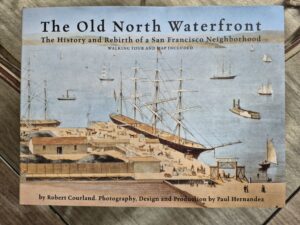
I wasn’t until a couple of months ago that we got a coffee table book detailing the history of our neighborhood, usually called the North Waterfront.


I knew that much of the San Francisco waterfront is land fill since the Gold Rush but I really hadn’t thought much about where the land fill came from. In the book is a drawing showing what was then called ‘Signal Hill’ coming right down to the beach along San Francisco Bay.

Reading further into the book, I discovered that Signal Hill was considered a prime source for landfill. In fact, for 20 years or so there was an actual quarry right along the east side of the hill.

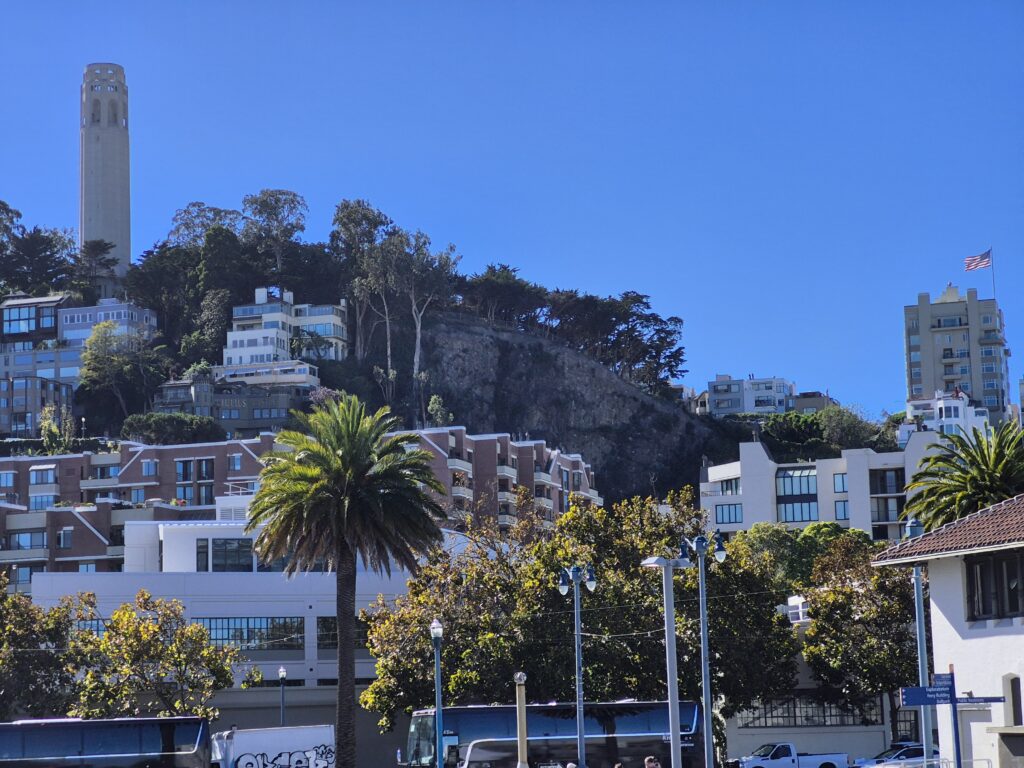
Nowadays, you can see the outline of the original hill if you look at it from out on the Embarcadero. Our condo is in the white building on the right mid distance. The Filbert steps are just out of the picture on the left.

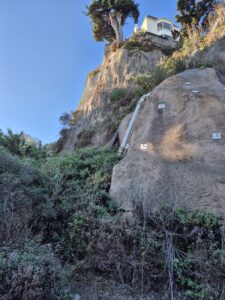
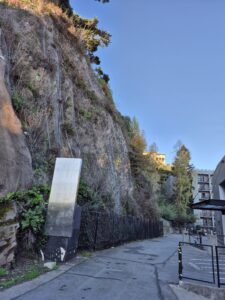
Walking up Chestnut Street, you can find a spot right next to the cliff that is the east side of Telegraph Hill now. Here are some views of that spot.


These views are looking south, southwest and west. Pretty steep cliff!

When we were looking for condos in the neighborhood, we looked at an apartment in the building just at the edge of the picture on the left. Looking out the living room window, there was a perfect close up view of that cliff. No thanks!

Where we live now doesn’t have a great view like we had in Brisbane. We are only on the second floor so we hear a lot of street noise but the windows are south facing and the sun comes in filtered by the trees most of the year. We like it a lot!


Dad the list maker

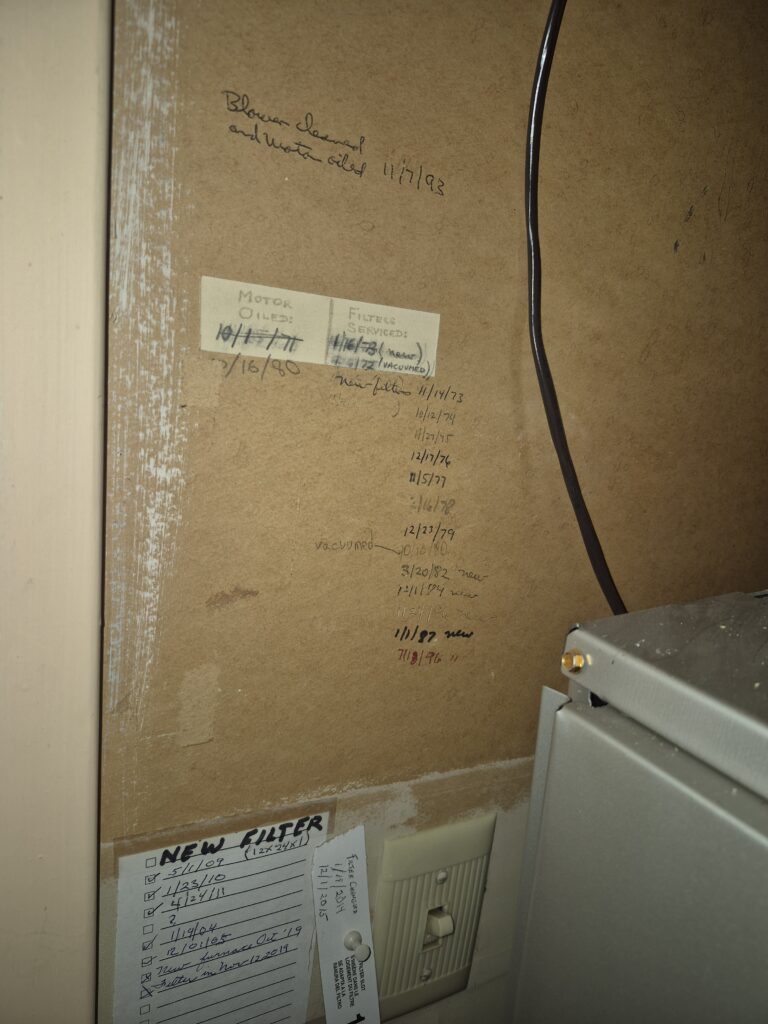
I only have one photo to support my thesis, but I’m going ahead anyway. Here’s the photo:

This is a view of the interior of the furnace closet. All the notations are in Dad’s writing documenting the dates on which he had changed the furnace filter.

He had installed a water softener not long after we moved to the Santa Clara house. The water softener uses salt pellets which periodically have to be added to a barrel in the garage. That system has been replaced at least once in the 60+ years and the one now in use is 15 or 20 years old. The lid of the salt barrel is filled with similar notations of when he had added salt pellets. It’s even more dramatic looking than the furnace closet.

In Mom’s car at this very moment, I am sure – without looking, I’m at home as I write this – there is a little book with notations showing every gasoline purchase since the car was new. She has faithfully carried on this tradition of Dad’s for years now. I’m not as sure that she is keeping the service records there as Dad did.

For many years, I carried on this tradition in my own vehicles as well. I finally realized that there was no benefit to me so I stopped. I can look at credit card records if I have to although I can’t use them to calculate mileage, as he did. I am guilty of occasionally putting dates on things that I use: ibuprofen, laundry detergent, potato chips, toothpaste, for example, so that I can gauge how long they actually last. Perhaps that was Dad’s motivation. I prefer to think that he was a scientist to the bone and always wanted to work from a position of factual knowledge.

To be fair, I never saw dates written on any perishables at our house growing up. Perhaps, with 6 kids, things got used up so fast it didn’t matter.

San Francisco streets

Since moving into the City, I’ve made it a habit to rehearse the order of the names of the streets as I go places. Despite them being literally next door, I still get Greenwich and Filbert mixed up. They both have stairs up Telegraph Hill. Filbert is more famous, probably because it is a bit nicer. Greenwich is closer to our place on Lombard.

After Filbert, heading into (what we still call) the Financial District, there is Union, Green, Vallejo and Broadway.

Today Sepi and I walked to our dentist, who is at 450 Sutter. Once on the downtown grid, every corner can be a choice as the distances all come out the same. Some blocks go up hills, though, so generally we go down Sansome for a while to get around the shoulder of Telegraph Hill. Whether the day is warm or cool often determines which side of the street we walk on. Today, before the low clouds burned off, we turned up Washington to skirt (what is still called) the Transamerica Building then going down Montgomery to Sacramento then Grant then Sutter.

What is really interesting to me now are the alleys.

Maiden Lane by Union Square is (or was) famous. Hotaling Place is lesser known but has a cool 1906 story. Leidesdorff Street has a nice mural.

Today, walking towards home on Grant, we saw an alley with no sign. Down at the end was a sign for a restaurant: The Irish Bank. Around the corner, I spied the other end of the alley – it takes a turn at the restaurant – which was named Mark Lane. Is it Mark Lane all the way through? No, according to Google Maps, the other part is Harlan Place. We asked at the restaurant but they didn’t know.

Another block farther on, we walked down Belden Place, which sported at least a half dozen restaurants in its single block. Pretty busy, too, at lunch hour. I’ve never even heard of Belden Place before today.

Many of the streets we walked on today I have driven on but we really enjoy going slow and looking at everything: the buildings entrances and decorations, the store windows, the people. I got a book once from the library that talked about all the San Francisco street names and how they got that way but it works better for me to do it organically. If I stand in a place and know the history, I can remember it better. It’s not as much fun to just jam facts into my brain to be spewed forth later.

Our (try to be) daily walks are often out on the Embarcadero. Certain places on the Embarcadero have brass plaques in the sidewalk with stories about the intersecting streets.

Francisco, Chestnut, Lombard, Greenwich, Filbert, Union . . .

Going the other way: Battery, Sansome, Montgomery, Kearney, Grant, Stockton, Powell, Mason, Taylor . . .

I’ve got to keep at it!

**************

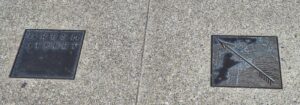
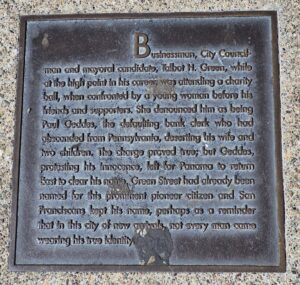
Addendum: We went out onto the Embarcadero today and I got a picture of one of the plaques I was talking about. It was for Green Street. There are actually six plaques set into the sidewalk. The top two show the name of the street and the direction to it from where we are standing.

The middle two show an image of Mr Green and tell Mr Green’s story. It basically says Mr Green was actually someone else with another name.
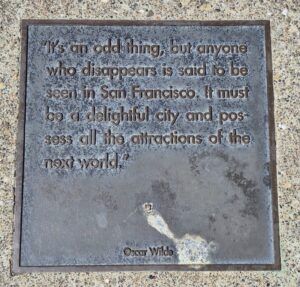
At the bottom is a final word. The seagull shit is such a San Francisco touch!

early guitar

I started playing the guitar ‘seriously’ the summer I was 15. The family drove across country to visit relatives and I took Dad’s (it wasn’t officially mine at that point) guitar with us in the van.

I didn’t really have a plan. I was just bashing away at it at odd times. It was what Bruce and I had been doing for the previous few months but taking on a trip was a new level of seriousness.

I’ve been trying to remember the order I did things. I had taken trumpet lessons in 5th grade so I knew how to read music but I didn’t know how to translate that to the guitar.

At some point, I went down to Moyer Music, which was within walking distance at the Food Villa chopping Center, and took some lessons from a guy named Terry. He had me buy the Mickey Baker book and showed me how to play ‘Corcovado’ and ‘The Shadow Of Your Smile’ in chord melody style. It meant very little to me then but it stood me in good stead later. I still have the Mickey Baker books. Two of them!

Despite all that, I never felt that being able to play anything that we heard on our records was attainable. Jimi Hendrix especially, but also Jerry, Jorma, Eric and the rest seemed other worldly. I remember being at a battle of bands and I heard a local guy play some great riff and I was gobsmacked. What mere mortal can do that??

I bought a book on blues guitar and worked up the Eric Clapton version of Freddie King’s ‘Hideaway’. I still can’t play the turnaround right though. I could get the first three notes of ‘Crosscut Saw’ but that was about it.

Nowadays, everybody talks incessantly about tone. For us, there was no idea that you could put some kind of tone modifying device between your guitar and your amp. Well, Hendrix had the wah-wah pedal. We all thought he just had his Marshall stack dimed for that great distorted sound.

It turned out he did anyway but he also had a distortion pedal. PAs were little in those days so the amp had to do a lot of work.

When I finally got a little money, I bought a Fender Twin Reverb because that was what Jerry Garcia used. I never had the courage to turn it up enough to get serious distortion out of it. (Of course, that’s what I wanted!) Nobody told me there were smaller amps that could do what I wanted. Pretty much all of our sources of information were word of mouth, which for me meant Bruce. No Internet, kids!

I had a Gibson ES-335 because Bob Weir and Boz Scaggs had one. It had a crack in the neck so I had it worked on by a shop in San Francisco. I think they ripped me off and didn’t really do anything except add a little bit of lacquer. I’m sure there were people who knew what they were doing, but I couldn’t find them. The guitar wasn’t great but it was nicer than I deserved.

Well, we had fun and made a little money. That stuff is all gone now and no regrets. I’ve got decent gear that does what I need. I can play a lot better now. I’ve taken a few lessons over the years and actually learned some things. Tone is still kind of mysterious though.

Tim K

I’m never quite sure about using people’s names on this blog. Generally I do it like this.

I got the news today that Tim K died last week. Tim was Tom’s younger brother and in my high school class. In other words, the same age as me.

Thinking back, Tim was really my entree to Tom. Tom, who was so important to me in my early rock band days. Tim and I were in some of the same classes together our Senior year of high school. Perhaps the most important to me was the Period 0 PE class. Because we had a full load of academic classes, we were allowed to take PE – because god forbid you don’t get PE – before the regular classes started. During PE basketball games we could talk to each other and became friends.

Tom was two years older and already off to college by this time but I had been envious of him and his band ‘Native Son’ from a couple of years before. When I wanted to put together a band for a church event, Tom graciously agreed to participate. Without knowing Tim I would have been too scared to talk to him.

The church band became April, which was a real thing for a couple of years. It was real enough for me to quit UCSC the next year because of it.

During those two or three years after high school, Tim and I palled around quite a bit. He often came along when my band was playing. We experimented with our bodies’ tolerance for alcohol. Really gross stuff in hindsight: Mickey’s Big Mouth, Schlitz Malt Liquor, Sloe Gin fizzes, Ouzo.

I don’t remember any incident that split us. Eventually, we just went our separate ways. Tim became an elementary school teacher in Fresno and while my relationship with Tom deepened, it did not carry over to staying in touch with Tim.

Tim never married nor had any long term relationships, as far as I know. Tom is going to Fresno to go through his apartment. I can’t help but think of the surprise we got when we went through Zach’s papers.

I always felt that Tim had so much going for him in high school. He was so gregarious then, it was always a surprise that he was so guarded about his life later. Teaching is an honorable profession but I thought he could have done a lot more. I suppose you could say the same about me. I never heard that alcohol played any part of him being so reticent. I always felt that he got over it as I did.

There is a backlog for the coroner’s autopsy. Maybe we’ll know more next week. In the meanwhile, Rest In Peace Tim. We had some good times together. I learned a lot from you. You deserved better than to die alone.

Getting older

What is it like getting older? How about this?

I was talking to a medical person this morning about a procedure that I had had. I could remember the procedure perfectly. I thought it was maybe about ten years ago. Then I started running the numbers.

It was before I moved to Pacifica in 2010. In fact, it was right around the time I moved to Suisun. Hmmm, 2007? How many years ago was that? Almost 20! Sheesh!

For some reason, things that happened longer ago, like when I worked at the Opera, or moved to Grass Valley, are easier to rationalize in memory. 30 years ago? 40 years ago? Whatever. When something that at first blush seems recent and it turns out to be 20 years ago . . . Man, I’m old!

MTT is 80

The Symphony is having a celebration of Michael Tilson Thomas’ 80th birthday this weekend. It is bittersweet because he has brain cancer and is in bad shape. There was a rehearsal yesterday that was opened to certain people. I was invited but I chose to not attend. My little group of retirees had discussed this a few months ago and the consensus was that we preferred to remember Michael as he was and not how he is.

I found a post (linked here) that I had written in October 2023 in which I said he would never return to the podium. In fact, he did return to the SFS podium the following March and he appeared again yesterday (and presumably will for the concert tonight). Amazingly, he’s also continued to conduct other orchestras around the world as well.

In general, he does ok while actually conducting, but rehearsing specific passages is highly problematic as he can’t navigate the pages very well. There are assistant conductors to help him. Off the podium, he’s very spaced out. Even a year ago, when I last saw him, he seemed only dimly aware of his surroundings. His husband Joshua, along with other helpers, was with him constantly.

Michael was the Music Director when I was hired as Stage Manager so I had an interview with him. For complicated reasons, it was over the phone. I spent most of the time trying to establish my bona fides as someone who had long standing ties to the orchestra and understood the art form. He was cordial but nothing I said animated him. As we worked together over the next 9 months, it was more of the same. He was nice enough, but distant. He already knew it was his last year as Music Director. In truth, I already felt that he had been phoning it in for a few years.

All the plans to celebrate his last year at the Symphony were blown up by Covid-19. Our massive European tour was cancelled and the final Mahler 6 that everyone was looking forward to in June 2020 never happened.

So, Happy Birthday Michael! I do not wish him many happy returns because I don’t think there will be any. Spaced out does not mean unhappy, though. Even a year ago, with his mind failing, he seemed happy. So, I wish him what happiness he can find until his days are over. When that happens, the many people who love him will be sad. No doubt the Symphony will put on a big memorial to celebrate his life.

I will go to that.

Practicing

I’ve always found it interesting that making music is referred to as ‘playing’. I think, we ‘play’ music; we ‘play’ in the sandbox. It really isn’t the same thing!

Playing music – mostly in the context of along with other people – has given me a lot of pleasure in my life. But in order to get to the level of competency required to make good music, one has to practice. Practice can mean noodling on a guitar along with rock records, as I did in my teen years, or it can mean focused playing of all manner of excruciatingly boring stuff for hours at a time. As the Stage Manager for the Symphony, I never lost sight of the fact that every single player in that orchestra had put in unfathomable hours in the second type of practicing. While most, if not all, of those players have what most people would call talent, I would argue that the most important thing that got them to the big time was the ability to practice long hours in a focused way.

This all has come to my mind this week as I prepare for the Skyline Band spring concert in about ten days. As a result of some issues with the previous bass player, I found myself two weeks ago suddenly back in the bass chair. I had been playing guitar for a change of pace. Guitar in a big band is about 90% superfluous so I could mess around and no one would care. Bass is just the opposite.

So, I’ve had to knuckle down and really practice. I was talking to Sarah a couple of weeks ago and telling her I was practicing more. She asked me how many hours a day I was practicing. I had to laugh, knowing how much she practices. 30 minutes on a good day, I said. She let it go. It’s more than I was doing on the guitar!

Of course, the standards of the SF Symphony, a top-notch professional orchestra, are different from a Community College jazz band. Nevertheless, the goal is the same: to play it right.

I’ve moved beyond thirty minutes a couple of times in the last week, but I’ve missed entire days too.

I guess I better get back to it . . .

Termination Shock

I really love Neal Stephenson’s writing. I love his ideas too, which makes reading his novels such a joy.

I can’t remember if Termination Shock is his latest novel or if he’s gotten another one out since, but it is fairly recent. What brought it to mind was a story on the Bloomberg TV news channel that Sepi was watching this morning. It was about some people who are making efforts to mitigate the global warming disaster that is happening to our world.

In the current reality described in the news show, it is some guys with balloons filled with sulfur dioxide they are launching into the (hopefully) stratosphere and another team of people in Australia working on establishing blooms of phytoplankton in the central oceans. The phytoplankton sequesters the carbon dioxide and sinks it to the ocean floor.

When I saw what the guys were doing, I immediately said, ‘That’s what Stephenson’s novel is about!’ to Sepi. In the novel, it is a rich oilman in Texas who has built a system for launching giant pellets of pure sulfur into the upper atmosphere. The rationale is the same, though. The story is that while the giant pellet guns help the North American climate, it causes the monsoon to fail in India (among other side effects). Despite efforts – by governments and others – to build other, similar guns, around the world, India takes action to destroy the original launcher in Texas.

Towards the end of the TV news story, they used the words ‘Termination Shock’. Wow! Not in relation to the book – they didn’t mention that at all – but in the original sense of once you start doing these things, you don’t know what will happen when you stop. I would say this is also known as the Law Of Unintended Consequences.

Stephenson’s book is filled with interesting characters woven together beautifully in a gripping story. It is the best that Science Fiction can be. Read it!